
Category Archives: Christ

A STANDARD FOR THE NATIONS

PMW 2023-089 by Kenneth L. Gentry, Jr.Cross over all

Isaiah provides us with a glorious and encouraging Messianic prophecy in Isaiah 11. Let us quickly summarize his teachings.

Isa. 11:1–2: a shoot will spring from the stem of Jesse
Along with Assyria, Israel has been chopped down to a stump (10:18–19, 33–34). Yet the Messiah, the true Davidic king, will arise from the lineage of Jesse (vv. 1, 10; David’s father, 1 Sam. 16:10–31). Christ is the greater David who was typified in David. He will be endowed with “the Spirit of the LORD” (v. 2), thereby exercising wisdom, understanding, counsel, strength, knowledge, and the fear of the LORD (v. 2).

Isa. 11:3–6: with righteousness He will judge the poor
Where Israel’s rulers failed and earned God’s judgment, the Messiah will exercise righteous rule (cf. v. 9).
Continue reading

PSALM 45 AND THE MESSIAH

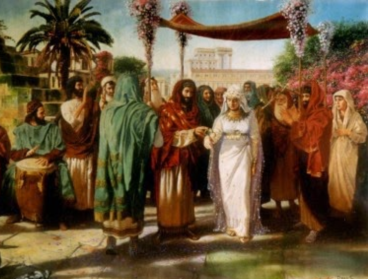
PMW 2023-087 by Kenneth L. Gentry, Jr.Ancient wedding

Psalm 45:1–7 is a royal wedding hymn psalm. It engages in praise that is so exalted that it is primarily Messianic in function. However, it could apply to an earthly king in an ideal sense as the goal at which his rule should aim. Yet its Messianic purpose is the ancient view among both Jewish and Christian interpreters. We even see its Messianic function in the New Testament (Heb. 1:8–9). In this regard, notice the following.

The title of this Psalm is the longest by far in all the Psalms: “For the choir director; according to the Shoshannim. A Maskil of the sons of Korah. A Song of Love.” This emphasizes its deep and solemn significance in presenting the glorious wedding hymn — for the Messiah.

Continue reading

WHAT DOES “THE SON OF MAN” MEAN?

PMW 2023-028 by Kenneth L. Gentry, Jr.

During his earthly ministry, Jesus repeatedly refers to himself as “the son of man” (Matt. 8:20; 9:6; 10:23; 11:19; 12:8; etc.). But what does this self-designation mean? How is it used in the Gospels?

As we consider this phrase in the Gospels, we must keep three important issues in mind: (1) Jesus is the only one who ever uses this phrase. Never do his disciples, the Jews, or anyone else mention it. (2) The phrase is always used with the definite article: “the son of man” (3) In Matthew’s Gospel, Jesus himself does not even begin using it until Matt. 8:20. Each of these points is significant. Continue reading

GNOSTICISM ARISING

PMW 2023-014 by Kenneth L. Gentry, Jr.Gnosticism

Sadly, gnosticism is arising within the evangelical church, despite Paul’s refutation of it in 1 Corinthians.

In his incarnation Jesus entered history as the Last Adam (1 Cor. 15:45), becoming a true and full human, body and soul (John 1:14). Thus, he came into this world as a whole person, body and soul (Heb. 10:5). And he died for our sins as a whole person, body and soul (Heb. 2:14). Then he ascended into heaven, body and soul (Acts 1:9–11), where he now lives, body and soul (Col. 2:9). Continue reading

PRIMER ON POSTMILLENNIALISM (4)

glowing-crossPMW 2021-064 by Kenneth L. Gentry, Jr.

I am continuing a study on the millennial reign of Christ. In this article I will focus on:

Christ and the Postmillennial Hope

In Christ’s earthly ministry we witness the coming of the prophesied kingdom. For instance, in Mark 1:15 we hear the Lord himself proclaim: “The time is fulfilled, and the kingdom of God is at hand; repent and believe in the gospel.” Thus, not only does he declare that “the” time is fulfilled (the prophetically-expected time) and that the “kingdom of God is at hand,” but he also associates it with the proclamation of the gospel. Later in Matthew 12:28 we read him state: “if I cast out demons by the Spirit of God, then the kingdom of God has come upon you.” Continue reading

SATAN AND HIS ANGELS IN REV 12:4

Satan rev 12PMW 2020-032 by Kenneth L. Gentry, Jr.

A reader asks:

Dr. Gentry, I just got done watching your Revelation series on DVD. I just had a few questions.

I noticed you didn’t really touch much on Rev 12:4, and I’ve always been curious as to the meaning of that verse. A lot of people use it to say that when Satan rebelled he took a third of the angels with him. But that verse doesn’t seem to be talking about his rebellion at all, but rather his defeat during Christ’s earthly ministry. If that’s the case, then are there any other verse that talk about a “third of the angels”? Or is Scripture actually silent about that?

My reply:

Thanks for watching my lectures on Revelation in the “Survey of the Book of Revelation” DVD set. Obviously I could not deal with every verse and every topic in the twenty-four lectures, but this is a good question and deserves a reply. Please consider the following comments on Rev 12:4. Clearly, the dragon is Satan, as John makes clear in Rev 12:9. But what does he mean we he speaks of his “tail” which “swept away a third of the stars of heaven and threw them to the earth”? Continue reading

LUKE 17 VS. MATTHEW 24?

PMW 2020-017 by Kenneth L. Gentry, Jr.

In this blog I have previously investigated the apparent problem involved when comparing Matthew 24 and Luke 17. See: “Orthodox Preterism and Luke 17.”

There I note that Matthew separates the local judgment-coming prophecies regarding AD 70 from the global ultimate-coming prophecies of the Second Coming and the Final Judgment. Many prominent evangelical preterist scholars recognize Matthew’s clear structure. Scholars such as:

J. M. Kik, An Eschatology of Victory (originally published as an article in 1948)

• R. V. G. Tasker, Matthew (Tyndale Bible Commentary) (1961)

• David E. Garland, Reading Matthew: A Literary and Theological Commentary on the First Gospel (1993)

Alistair I. Wilson, When Will These Things Happen: A Study of Jesus as Judge in Matthew 21–25 (2004)

R. T. France, The Gospel of Matthew (New International Commentary on the New Testament) (2007)

R. C. Sproul, Matthew: An Expositional Commentary (2013)

Jeannine K. Brown, Matthew (Teach the Text Commentary Series) (2015)

• Jeffrey A. Gibbs, Matthew 21:1–28:20 (vol. 3 of the Concordia Commentary on Matthew) (2018)

See my blog article: Best Matthew Commentaries. Thus, this view is not “Ken Gentry’s view,” as I frequently hear from Hyper-preterists. I got it from others. It is a well-known, highly-regarded view published by a number of reputable scholars.

As I have pointed out elsewhere, this clean separation is quite evident in Matthew 24:34–36. There Matthew’s peri de (“but concerning”) narrative transition-formula shifts his attention away from the known time of his local (metaphorical) judgment-coming against the Temple (Matt. 24:2) in Judea (Matt. 24:16), which was to be in “this generation” (Matt. 24:34). He shifts his attention to “that day and hour,” which timing neither he nor the angels know (Matt. 24:36, 50; 25:13). [1] Continue reading