Category Archives: AD 70

OF PRETERISTS AND POSTMILLENNIALISTS (1)

PMW 2023-055 by Kenneth L. Gentry, Jr.

Awhile back I was interviewed about the relationship of postmillennialism with preterism. Here is the interview. I hope it will provide some insights for you as you discuss such issues with your friends.

Interviewer: Dr. Gentry, when we speak of “schools” of interpretation or theological opinion — like “theonomists,” or “postmillennialists,” or “preterists” — there is a tendency to think of these groups in monolithic terms, as if all their proponents hew exactly to a single “party line.” In what ways, if any, does the contemporary revival of biblical postmillennialism differ from earlier versions within the Reformed tradition (e.g., Puritan postmillennialism)?

Gentry: You are correct that we need to be aware of a lack of lock-step unanimity in any millennial viewpoint, including postmillennialism. “Puritan postmillennialism” is so widely variant that for sorting through the various positions, I highly recommend reading Crawford Gribben, The Puritan Millennium: Literature & Theology 1550-1682 (Dublin, Ireland: Four Courts Press, 2000).

But in broad strokes we may distinguish between an historicist postmillennialism (held by the Puritans) as opposed to a preterist postmillennialism which is currently the more popular view. Continue reading


1 THESS. 4 AND THE OLIVET DISCOURSE

PMW 2023-017 by Kenneth L. Gentry, Jr.double vision 2

Recently a reader responded to one of my articles with a lengthy question. Rather than quickly answering it and moving on, I have decided to provide an answer in a full article. Perhaps later I will deal with it even more thoroughly in a series.

MY READER WROTE:

I’m not advocating for full preterism, but reading Mt. 24 and 1 Thess. 4-5 side-by-side (noted below) I can see a 1st century fulfillment in both places. To me, the only real clear passage that speaks to the end of time as we know it is, 1 Cor. 15:24.

Further, I am of the opinion that all of Mt. 24/25 was fulfilled in AD 70 as well, or is in the PROCESS of being fulfilled (an ONGOING reality). Further to the point, in Matthew 25, the bridegroom of the wise and foolish virgins returns to the same people he left. Similarly, the parable of the talents tells us the lord of the servants returned “after a long time” to the same people he left. “Now all these things happened to them as examples, and they were written for our admonition, upon whom the ends of the ages have come.” 1 Cor. 10:11. Continue reading

THE KEY TO OPENING REVELATION

PMW 2022-079 by Kenneth L. Gentry, Jr.

There are several keys to interpreting the Book of Revelation. But the key key is that of John’s statement regarding the prophetic events being near. When I discuss Revelation with folks I begin by urging them to read the first three verses. Once the shock wears off their faces, the gears in their head will often begin to turn.

Thus, the leading preterist evidence derives from John’s temporal delimitations, which he emphasizes by strategic placement, didactic assertion, frequent repetition, and careful variation. Continue reading

KEY PRETERIST PRINCIPLES

PMW 2022-072 by Kenneth L. Gentry, Jr.

Modern postmillennialism is largely, though not solely, committed to a particular interpretive tool known as “preterism.” This tool is helpful for explaining many of the catastrophic judgment passages as features of the founding of Christianity in the first century rather than evidence for the decline of Christianity in the final century.

However, postmillennialists do not adopt this interpretive approach in order to avoid a negative impact on their eschatological system. Rather, preterism arises naturally from a careful reading of the biblical text. Continue reading

AD 70 & THE TEMPLE’S FAILURE (2)

PMW 2022-062 by Kenneth L. Gentry, Jr.

I am completing a brief study on the Jewish temple’s failure through abuse, showing the necessity of its destruction under God’s wrath in AD 70. My previous article should be consulted for context.

Interestingly, on several occasions before Christ’s coming, the temple undergoes cleansings because of profanations by Ahaz (2Ch 29:12ff), Mannaseh (2Ch 34:3ff), Tobiah (New 13:4-19), and Antiochus (1Mac 4:36ff; 2Mac 10:1ff). The temple of Christ’s day is also corrupt, for Christ himself symbolically cleanses it when he opens his ministry (Jo 2:13-17) and as he closes it (Mt 21:12-13) — even though it is under the direct, daily, fully-functioning administration of the high priesthood. Continue reading

AD 70 & THE TEMPLE’S FAILURE (1)

PMW 2022-061 by Kenneth L. Gentry, Jr.

AD 70 is an important date in redemptive-history. In that year the ancient temple of Israel was destroyed, never to be rebuilt. This catastrophe is anticipated in the OT. Over and over again the temple cult is disparaged by the OT prophets when Israel falls into sin: Isa 1:10-17; 29:13; 43:23-24; Jer 6:20; 7:1-6, 21-22; 11:15; Eze 20:25; Hos 6:5-6; Am 4:4-5; 5:21-25; 9:1; Mic 6:1-8; Mal 1:10. Jeremiah even presents God as dramatically denying he ever directed Israel to sacrifice: “For I did not speak to your fathers, or command them in the day that I brought them out of the land of Egypt, concerning burnt offerings and sacrifices. But this is what I commanded them, saying, ‘Obey My voice, and I will be your God, and you will be My people; and you will walk in all the way which I command you, that it may be well with you’ “ (Jer 7:22-23). Continue reading

A NEW HYPERPRETERISM REBUTTAL

PMW 2022-057 Kenneth L. Gentry, Jr.

Though Hyperpreterism (a.k.a. Full Preterism) remains a small movement, it also remains a tenacious and noisy one. While Hyperpreterists believe they are giving sound advice regarding biblical interpretation and scriptural eschatology, they provide 99% sound and only 1% advice.

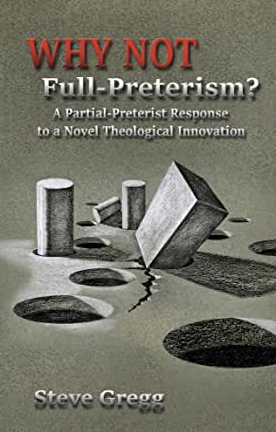
Yet Hyperpreterism does exist and it is present in some evangelical communities and local churches. Therefore, it is deserving of evangelical critiques. And Steve Gregg has provided a helpful, large-scale critique and rebuttal of this eschatological error, titled: Why Not Full-Preterism? A Partial-Preterist Response to a Novel Theological Innovation. Gregg is the host of the national Christian talk show, The Narrow Path. He is also the author of the invaluable book Revelation: Four Views: A Parallel Commentary (1997; rev. 2013).

Continue reading