
PMW 2025-099 by Kenneth L. Gentry, Jr.
In the modern evangelical world, we live in a dispensational-dominated reality. The average Christian leads a colorful life of expectation. He is either looking for a red heifer or a blood moon, while he plays pin-the-horns on the Antichrist. Consequently, it is difficult to get a hearing on even the possibility of a preterist analysis of everyone’s favorite book of the Bible: Revelation. And by this I mean, of course, an orthodox preterist approach to Revelation. Not the wholesale preterist theology of hyper-preterism, which is unorthodox heresy.
So, how can you introduce a preterist approach to Revelation in just the few minutes you will have before your head is bashed in with the New Scofield Reference Bible, or one of the other two dozen or so dispensational study Bibles written by “prophecy experts”? We must take to heart Jesus’ directive: “What thou doest, do quickly.”
With this in mind I would like to recommend the following quick and easy way to introduce the unsuspecting Rapture advocate to a preterist understanding of Revelation. And if this does not work: who needs friends, anyway?
The Beast of Revelation
by Ken Gentry
A popularly written antidote to dispensational sensationalism and newspaper exegesis. Convincing biblical and historical evidence showing that the Beast was the Roman Emperor Nero Caesar, the first civil persecutor of the Church. The second half of the book shows Revelation’s date of writing, proving its composition as prior to the Fall of Jerusalem in A.D. 70. A thought-provoking treatment of a fascinating and confusing topic.
For more study materials, go to: KennethGentry.com
Where to Start
The most important directive for broaching the preterist approach to Revelation is to pick just one key passage. Don’t bite off more than they can chew. A well-chosen passage will either quickly disarm your earnest Rapture-theorist, or will cut your conversation short. Even the second prospect can be practical, saving you much time so that you can enjoy the “Leave It to Beaver” re-runs that everyone loves and cherishes so much. (Not me, of course. I prefer “The Lone Ranger,” since I was brought up in a Scofield-addicted family. In fact, my uncle who was my pastor when I was a teenager, would usually open his sermon from the Scofield Reference Bible in a familiar way. He would say “We will be focusing on X chapter and verse, which is on page X — if you have a good Bible.” In fact, we would all know what Sunday’s sermon was going to be any time there was an earthquake of over 2.3 on the Richter Scale anywhere in the world. This would be true even if church members checked the amended Guenberg-Richter scale. I would note, however, that my uncle discouraged excitement based on the Moment Magnitude Scale — for obvious reasons, or at least reasons that were obvious to him. And this was especially true if the quake was during a full moon after a dusky sunset or during the annual Leonid meteor shower. But I digress. Plus it is time for “Leave It to Beaver” and I have to turn the channel from “The Lone Ranger” so the rest of my family can get a little enjoyment out of life.)
Now back to work.
But before that, a word from our sponsor: me!
BEFORE JERUSALEM FELL
Doctoral dissertation defending a pre-AD 70 date for Revelation’s writing (459 pp; paperback). Thoroughly covers internal evidence from Revelation, external evidence from history, and objections to the early date by scholars.
For more study materials: https://www.kennethgentry.com/
The Problem We Face
Revelation is universally recognized to be the most difficult book in the Bible. (I guess the only easy thing about Revelation is that it is the last book in the Bible, so that you can always find it quickly. This makes it easy to play dispensational “sword drills.”) Revelation is especially difficult if you have a foreign language version of the Bible and you don’t speak that language. Or if you have the US Navy version of the Bible which uses only signal flags (personally I am red-green color blind and could never read too far in that Bible, making it only as far as the 13.78221 billion year gap between Gen. 1:1 and Gen. 1:2).
Furthermore (trying to get back on track, after wondering for a minute: Who am I? And why am I here?), Revelation is difficult because it requires a deep knowledge of both the OT and the apocalyptic style of writing. This genre hasn’t been popular since AD 105. That was the year when Trajan mispronounced the word “apocalyptic” in a public speech, and, out of humiliation, forbade further discussion of the matter. Thus, it has always amazed me that young converts often want to study Revelation before they even have a good grasp of the rest of the Bible (their poor grasp often causes them to let the Bible slip out of their hand — especially if they haven’t paid their gravity bill, which reminds me, I need to pause for a minute and run out to the mailbox).
Starting Properly
What one singular key passage would I choose to introduce the preterist understanding of Revelation? I always encourage my hapless acquaintance to “begin at the beginning.” Most people want to high tail it to “the good stuff” when they open Revelation: they want to know all about the seven-headed beast and his mysterious three numbers, 6 and 6 and 6 (not realizing that in the Greek it is one number: six-hundred and sixty-six). But this all comes much later in Revelation (in the thirteenth chapter well past Revelation’s midpoint).
So then, you must encourage your cornered friend to resist the irresistible temptation to leap-frog into the exciting parts of Revelation. I once had an earnest Christian friend who leaped ahead so quickly and so vigorously in Revelation that he actually went past Revelation 22:21 and began expositing the “Genuine Cowhide” marking on his Bible’s back cover. He had not noticed this gold-embossed imprint before and thought it must contain a hidden message about the famed red heifer. He even scratched off the gold-foil embossing in seeking that message underneath.
The Book of Revelation Made Easy
(by Ken Gentry)
Helpful introduction to Revelation presenting keys for interpreting. Also provides studies of basic issues in Revelation’s story-line.|
See more study materials at: www.KennethGentry.com
In fact, this happened to my friend more than once. I was with him once when he became greatly disappointed while witnessing to someone he bumped into while checking a phone booth to see if someone had left a quarter in it. My friend made the fatal mistake of leaving his leather-bound Bible at home and had to use this other fellow’s Bible. But it was a paperback study Bible! Surprisingly this Bible had as its last words on the back cover: “Genuine Paper.” This confused my friend no end (he still talks about this to this day, some six decades later; in fact, I am tired of hearing about it.)
Nevertheless, this faux pas did remind my despondent friend that he should take his own Bible with him at all times, so as to avoid unpleasant surprises. And this would be especially important for him since his own Bible had penciled-in corrections that helped his eschatology fit together more easily.
Semi-conclusion
Well, darn! You know what? I was actually starting a serious study article when I got side tracked after the first sentence. I should not have lingered so long in my Roget’s Thesaurus while trying to collect my thoughts (both of them).
Sometimes my mind wanders. One time it wandered all the way to Cleveland and picked up a whole case of Bertman’s Original Dortmunder Beer Mustard. This proved to be too heavy to haul back to my cranium in South Carolina, forcing me to fly up there to secure both my wandering mind and its new payload.
I normally am afraid to fly because Jesus said, “Low, I am with you always.” I don’t like to take chances, which might be one reason I have never won the Powerball lottery — apparently that is a chance-oriented matter. However, as a good Christian, while I was in Cleveland I did “redeem the time” by enjoying a box of Malley’s chocolates and the seventh inning of a Cleveland Indians ball game. This was before it was illegal to refer to an Indian as an “Indian,” i.e., it was a time before children started playing cowpersons and native Americans by the new international rules.
I had better go now. My wife says supper is ready, and my stomach is saying, “Yay!” But in my next article I promise to collect my thoughts before writing so that I can offer some helpful advice.
To make Revelation easier to understand, I have written an 1800-page, two volume commentary on it:
The Divorce of Israel: A Redemptive-Historical Interpretation of Revelation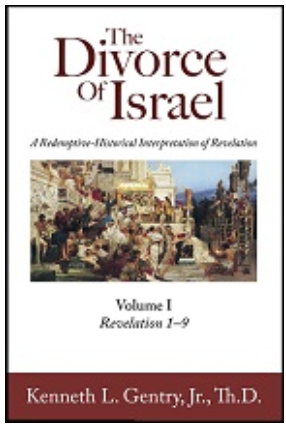
This long-awaited commentary has now been published. It is an 1800 page, two-volume deeply exegetical, academic commentary on the Bible’s most mysterious book.
Click: https://www.kennethgentry.com/the-divorce-of-israel-2-vols-by-gentry-pre-publication-offer/
See more study materials at: www.KennethGentry.com



 Postmillennial Worldview
You were in rare form when you wrote this! I would be questioning your sanity had you not made reference to your love of “The Lone Ranger”. I am pretty sure Revelation addresses white horses, silver bullets, and faithful companions somewhere…I think on the last page. 🙂 I am only about 1/2 way through your Revelation commentary…and haven’t yet come across your exposition on same.
Nice one, Dr. Gentry!
I can imagine it may be a quite difficult effort to explain Orthodox Preterist eschatology to a hardcore Dispensationalist, since they are so dedicated to the literal and clear meaning of passages that it may be hard for them to grasp that “this generation” and “very soon” means “The Apostles’ Generation” and “in a short while”, rather than the ‘literal and clear meaning’ of “the 1948 generation” and “in a very long while”!
Jokes aside and on another note, I believe you may remember me from earlier this year. I have sent you a message through the contact form regarding one of your books; if you could answer me as soon as you are able to, I would be grateful!
God bless your ministry!