
PMW 2025-070 by Kenneth L. Gentry, Jr.

I have quickly glanced at several of the kingdom parables in my previous posts. In this posting I will continue doing so. This time we come to two parables that are strongly postmillennial: The parables of the mustard seed and of the leaven. Let’s quickly review this powerful parables.
The Parable of the Mustard Seed (Mt 13:31–32) and the Parable of the Leaven (Mt 13:33). These two parables instruct us regarding the kingdom’s gradual development and ultimate outcome. I will consider these parables a little more closely since they greatly impact the postmillennial argument.
The Parable of the Mustard Seed
This parable reads:
“The kingdom of heaven is like a mustard seed, which a man took and sowed in his field, which indeed is the least of all the seeds; but when it is grown it is greater than the herbs and becomes a tree, so that the birds of the air come and nest in its branches” (Mt 13:31–32).

Navigating the Book of Revelation (by Ken Gentry)
Technical studies on key issues in Revelation, including the seven-sealed scroll, the cast out temple, Jewish persecution of Christianity, the Babylonian Harlot, and more.
See more study materials at: www.KennethGentry.com
Unquestionably, the image symbolizes something magnificent beyond expectation: a minuscule mustard seed giving rise to a large tree.
Though birds could easily eat a mustard seed, the mustard tree becomes large enough that they flock to it in order to build their nests for their young. The Old Testament provides similar imagery that assists us: birds singing among the tree branches picture peaceful serenity and divine provision (Ps 104:12, 17). In Daniel 4:12 and Ezekiel 31:3, 6 Daniel portrays Babylon and Assyria (which God providentially prospers, Jer 27:5–8; Eze 31:3, 9; Cf. Ps 75:6–7; Da 2:21; 4:17, 32; Job 12:23) as massive kingdoms to which birds flock to build their nests. Daniel 4:12 indicates that this speaks of the gracious provision of food for all; Ezekiel 31 shows that this symbolizes the kingdom’s fairness, greatness, and provision for all great nations. That is, these kingdoms were great for a time, securing provisions and shelter for men.
But God has a kingdom that also will become a great tree providing a nesting place for the birds and their young. Ezekiel 17:22–24 reads:
“I will also take of the highest branch of the high cedar, and will set it; I will crop off from the top of his young twigs a tender one, and will plant it upon an high mountain. In the mountain of the height of Israel will I plant it: and it shall bring forth boughs, and bear fruit, and be a goodly cedar: and under it shall dwell all fowl of every wing; in the shadow of the branches thereof shall they dwell. And all the trees of the field shall know that I the Lord have brought down the high tree, have exalted the low tree.”
This symbolizes the universal magnificence and exaltation of the kingdom of heaven, which will graciously provide shelter for all, when it comes to full fruition. Daniel’s vision seems to provide the specific backdrop of Christ’s parable, which he adapts by recasting it as a mustard plant. Both point to the dominance of Christ’s kingdom: the twig is planted on a high mountain above all the trees; the mustard seed becomes the largest plant in the garden. So then, the Mustard Seed Parable speaks of the kingdom’s extension in the world (cp. 13:37–38).
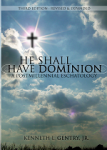
He Shall Have Dominion (paperback by Kenneth Gentry)
A classic, thorough explanation and defense of postmillennialism (600+ pages). Complete with several chapters answering specific objections.
See more study materials at: www.KennethGentry.com
The Parable of the Leaven
This parable reads:
“The kingdom of heaven is like leaven, which a woman took and hid in three measures of meal till it was all leavened” (Mt 13:33).
Here Christ symbolizes the kingdom’s intensive progress in the world. Leaven is a penetrative agent that diffuses itself throughout its host from within (cf. Lk 17:20–21). Thus, here the leaven will thoroughly penetrate the whole three pecks of meal (surely “the world,” as in Mt 13:38). As Trench explains: “Nor can we consider these words, ‘till the whole is leavened,’ as less than a prophecy of a final complete triumph of the Gospel — that it will diffuse itself through all nations, and purify and ennoble all life.” The kingdom of heaven will have “a dramatic effect on human society.” B. B. Warfield notes of these parables that they “announce the complete conquest of the world by His King-dom.”
The leaven parable, then, parallels the kingdom’s glory in the other parables. The kingdom will penetrate all (Mt 13:33). It will produce up to a hundred-fold return in its converts (Mt 13:8). It will grow to great stature (Mt 13:31–32). It will dominate the field/world (having sown the wheat seed in the world, that world to which Christ returns will be a wheat field, not a tare field, Mt 13:30).
Both the mustard seed and leaven parables picture the kingdom’s growth. Clearly Christ is proclaiming in these kingdom parables the nature of the kingdom, which he is establishing and promoting during his ministry. His ministry opens by proclaiming “the kingdom of heaven is at hand” (Mt 4:17; cp. 3:2; 10:7). He immediately sets out preaching that kingdom (4:23) as a present reality (5:3, 10, 19; 6:33; 9:35; 12:28), which begins in earnest in the days of John the Baptist (11:11–12). It does not come catastrophically as a full-blown kingdom, but slowly grows to dominance. This gradualism contradicts the premillennial view. I will deal with the principle of gradualism below.
Navigating the Book of Revelation (by Ken Gentry)
Technical studies on key issues in Revelation, including the seven-sealed scroll, the cast out temple, Jewish persecution of Christianity, the Babylonian Harlot, and more.
See more study materials at: www.KennethGentry.com
Jesus Undermines Premillennialism
The Kingdom Parables, then, outline the postmillennial system in a way contradicting premillennialism:
- The kingdom begins in the first century as Christ ministers God’s word among men (13:24, 37). It does not await the distant future thousands of years after Christ’s ministry on earth, as per premillennialism.
- The kingdom comes by spreading the word (13:3, 19, 23). It does not appear in the context of a Battle of Armageddon. Nor does it involve any armed conflict whatsoever, as per premillennialism.
- The kingdom works within, from the heart (13:19) involving conversion (13:23). It is not essentially a political, bureaucratic reality that is imposed upon a recalcitrant world from without, as per premillennialism.
- The kingdom calls for a life of heart-felt commitment (13:44–46). It does not involve political choices or imposed subservience, as per premillennialism.
- The kingdom struggles against various hindrances and false starts (13:4–7, 19–22). It does not powerfully impose itself by overwhelming the world in a great battle, as per premillennialism.
- The kingdom is a valuable reality that not all men realize, being hidden (13:44–46). It does not picture a kingdom that comes full scale and publically upon men, as per premillennialism.
- The kingdom operates in the world even as Satan resists it (13:19, 25, 38–39). It is not protected by a literal binding of Satan so that he is absolutely restrained from any earthly activity, as per premillennialism.
- The kingdom results in a wide range of responses, including some rejecting it and others only temporarily accepting it (13:4–7, 19–22). It operates in fits and starts rather appearing catastrophically and universally, as per premillennialism.
- The kingdom even includes unbelievers within it (13:24–26, 47–48). It does not come through a battle that destroys all opposition and allows only the saved to enter it, as per premil-lennialism.
- The kingdom grows from an insignificant beginning, gradually producing results over time (13:8, 23, 31–33). It does not dramatically and catastrophically appear on the scene of history all at once, as per premillennialism.
- The kingdom gradually grows from the first century, resulting in remarkable, dominant growth, which ultimately penetrates the whole world (13:31–33). This universal, pre-second advent dominion contradicts premillennialism (and amillennialism).
- The kingdom grows as a present reality until the resurrection and judgment at the end of the age, where God finally separates the saved and the lost (13:30, 49–50). The kingdom does not involve a two-fold resurrection separated by 1000 years of a new and different age, as per premillennialism.
- In the imagery of the parables, the angels remove the lost from the kingdom for judgment before the saved (13:30). This contradicts the unique dispensational scenario.
- The kingdom reaches perfection only at the resurrection (13:43). This contradicts complaints of some that postmillennialism suggests universalism and perfection.
Click on the following images for more information on these studies:



 Postmillennial Worldview
You are incorrect regarding the mustard seed and leaven. if you look at what Jesus has said immediately in the previous parables, he speaks negatively of the birds. They are Satan snatching away what they had. Also he warned the apostles watch out for the leaven of the scribes and pharisees, which was the hypocrisy. Has Satan secured lodging in the branches of the Kingdom of God? Yes look at the false teachings of the many denominations. teaching like the trinity, hell fire, once saved always saved and the immortal soul doctrines. these are all doctrines of demons. Is there hypocrisy in the churches that has permeated the whole mass? Their corrupting influence, characterized by legalism, hypocrisy, and self-righteousness. Jesus warned his disciples to beware of this corrupting force, using the metaphor of yeast that spreads and affects an entire batch of dough to symbolize how their false teachings and attitudes could permeate and ruin the spiritual lives of believers. This is the reason why only a few will find life and they have appointed teachers to tickle their ears, and MANY will do “wonderful works” but he will reject them as doing works of lawlessness. The apostles warned us that after their going away wolves would enter among them. All of this has happened. have you not seen around the world the Muslims flourishing and the churches are empty?
I have a pastor friend who recently described his journey from Amillennialism as “being dragged kicking and screaming into Postmillennialism”! I’ve been nudging him — not dragging — for ten years and more. I sent him a link to this article.
I especially appreciate the proof texts that connect the parable to OT illustrations that represent kingdoms as trees, and the point by point contrast between pre- and post-mil views of the kingdom.
I noticed something I had not thought about before. If every true believer brings forth at least thirty-fold, and some an hundred, how can the kingdom not continually increase? Do you think Jesus meant numerical increase, as a famer calculates the productivity of his seed? Or am I being too literal?
Keep up the good work, doctor. My knowledge of things post-mil has increased at least thirty-fold through your influence.
If God’s people are salt and light and light drives out the darkness, then there ought to be some way of measuring the progress in the growth of the Kingdom of God that is at hand, has come, and is here within every true believer.
In one census 60% professed to be Christians, a decline over the past few years. In the 1990s, approximately 90% identified as Christians. In 2007, approximately 78% identified as Christians.
Martin Luther is quoted to have said, “You can profess with the loudest of voices your faith in Jesus Christ, but by your actions you confess where your heart truly lies.”
What is advancing here? Is it the number of professing Christians that evidences the advancement of the Kingdom of Heaven on the earth, or is it the number of confessing Christians that provides this evidence?
We will agree that the government of the Kingdom of Heaven was laid on the “shoulder” of King Jesus and that there will be no end to the “advancement of government” of the Kingdom of Heaven.
How does the government of the Kingdom of Heaven advance, and how can this advancement be measured?
I would think the advancement is not measured by the number of men and women who profess to be Christians, but rather by the number of men and women who confess to be Christians by being united in the body of Christ (Church) under one form of government. And that one form of government would be the government of the Kingdom of Heaven laid on the shoulder of King Jesus.
God’s people could not be united under two forms of government, one being an earthly secular humanistic form and the other a heavenly form that is present in every true “confessing” believer.
Perhaps we, like Abraham, ought to “by faith” begin to live in the land where we are located, as sojourners living as in a foreign country in temporary dwellings (tents) rather than in permanent residences.
Are we like Abraham, by faith looking for a city which hath foundations, whose builder and maker is God, or are we entangled in secular affairs attempting to make the unclean government of men look more clean? We are to drive out the darkness, not make the darkness look less dark.
Abraham embraced the promises and “confessed” that they were strangers and pilgrims on the earth. Who did Abraham confess to if not the civil authorities in the promised land? There must be someone to confess to.
Abraham, if he truly was thinking about the country from which they came, they might have had the opportunity to return. But they did not return because they were seeking a better heavenly country where their God had prepared for them a city in which their domicile, or one fixed and permanent home, was established for them.
They “confessed” to be sojourning strangers on the earth, “transient foreigners,” in legal terms, and we ought to, by faith, make the same confession to the civil authorities in the country where we are like Abraham sojourning stranger living as in a foreign country looking for a better heavenly country where God has prepared for us our one fixed and permanent home.
In Hebrews 11:16, we read that God was not ashamed to be called their God because of Abraham’s confession, declaration, and his dwelling as if in a foreign country rather than a citizen and member of the secular humanistic body politic in authority in the promised land at the time of his sojourn.
Also, if we are to act in the Kingdom of Heaven office of ambassador for King Jesus to the pagan nations of people, then we wouldn’t accept a grant of secular citizenship in the country in which we are to act as an ambassador for a foreign country and King?
An ambassador is legally recognized as having his or her domicile in the country from which he or she was sent to be an ambassador in a foreign country.
So, do we measure the growth of the Kingdom of Heaven in time and history by the number of men and women professing to be fellow citizens with the saints and member of the household of God, or by the number of men and woman who confess to be Christian by their coming out and separating themselves from membership in the secular humanistic body politic under the civil jurisdiction of the secular humanistic government and come into and under the government laid on the shoulder of King Jesus and begin to do our job as soldiers and ambassadors for King Jesus and the Kingdom of Heaven?
I cannot comprehend how God’s people can be united under two forms of government and owe their absolute allegiance, fidelity, and obedience to both.
The legal definition of the word “Church” in Black’s Law Dictionary is:
Church – In its most general sense, the religious society [not secular society] founded and established by Jesus Christ, to receive, preserve, and propagate His doctrines and ordinances [not secular ordinances]. It also means a [separated] body of communicants gather into church order [and out of secular civil order], and it is a body or community of Christians united under ONE form of government by the profession [and confession] of the same faith and observance of the same ritual and ceremonies …”
If we unite and gather together in the living room, can we also be united and gathered together in the kitchen at the same time?
If we are called to come out and be separate from the unclean thing, and we do so, can we remain in the place from which we have come out?
Is the postmillennial hope realized in the number of professing Christians entangled in secular things on earth at a given time, or by the number of “confessing” Christians who have come out of the secular form of government and have become united under one Kingdom of Heaven form of government and who are acting in the office of ambassadors for King Jesus and the Kingdom of Heaven form of government calling God’s elect among the pagan nations of people to come out separate and be reconciled to God?
To be salt and light, a believer is required to separate from the darkness and unite with God’s people in the body of Christ. The 64-dollar question is, has God provided a lawful way recognized in the civil law itself for God’s people to truly separate and serve the Lord their God and Him alone?
Of course, He has, and we ought to be talking about the lawful way God has provided for His people to come out and unite under the Kingdom of Heaven form of government. Of course, we would have to give up the leeks and onions (government ascribed privileges, benefits, and protection) and look to God for these things.
Peace
The mustard seed parable show the conversion of the birds Satan had used. The parable very clearly says: “the kingdom of heaven is like.”