
PMW 2025-041 by Kenneth L. Gentry, Jr.
 In this article I will be looking at the Noahic Covenant. As we might expect, Noah was a postmillennialist. And probably Mrs. Noah (since they seem to have gotten along well in cramped quarters. Her name, by the way, was Joan of Ark).
In the Noahic Covenant appear various features which undergird the postmillennial hope of victory in history. We find this particularly in Genesis 6:17–22 and 8:20–9:17. Here God reaffirms the Cultural Mandate, which is fundamental to the outworking of his eschatological purpose through his highest creature, man. Thus, we are witnessing God’s continuing gracious redemptive relation to man as the ongoing basis of the Cultural Mandate. We see this also in the references to the birds, cattle, etc. (cp. Gen 6:20; 8:17 with Gen 1:24, 25), the command to “be fruitful and multiply” (Gen 9:1, 7 with Gen 1:28), and the dominion concept (cf. Gen 9:2 with Gen 1:28). This is necessary to the redemptive-historical character of eschatology.
God establishes this covenant with his people: the family of Noah, which alone escapes the deluge by God’s grace (Heb 11:7; 1 Pet 3:20; 2 Pet 2:5). Thus, this is not solely a common-grace covenant, for God establishes it with his elect people (Noah’s family) and on the basis of sovereign grace and redemptive sacrifice (Ge 6:8; 8:20–22). Furthermore, Scripture unites the Noahic covenant with God’s other redemptive covenants (cf. Hos 2:18 with Gen 6:20; 8:17; 9:9ff). The Cultural Mandate, then, especially relates to the function of God’s people in the world: God expressly reaffirms the Mandate with God’s people, the “you” of Genesis 9:1–12. On the basis of divine covenant God calls his people to the forefront of cultural leadership, with the religious aspects of culture being primary.
In revealing the Noahic covenant we also witness God’s objective relationship with man: God judges the world in history for its sin. God establishes the rainbow as a sign of his covenant mercy with Noah and all that are with him, including their seed (Gen 9:12). This indicates that the world will be protected from God’s curse through the presence of God’s people. God makes the covenant only indirectly with unbelievers, who benefit from God’s protection only as they do not oppose God’s people. Because of God’s love for his people, he preserves the orderly universe (Gen 8:20–22).
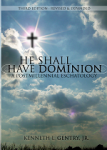
He Shall Have Dominion
(paperback by Kenneth Gentry)
A classic, thorough explanation and defense of postmillennialism (600+ pages). Complete with several chapters answering specific objections.
See more study materials at: www.KennethGentry.com
Thus we see God’s objective corporate sanction against sin in the Flood, which also serves as a type of final judgment (2Pe 3:4–6). We also witness God’s judicial sanctions in history in his ordaining capital punishment (Ge 9:6). God’s objective judgment therefore finds civil expression in man’s affairs. The Lord grants legitimate authority to the civil government to enforce capital punishment. God bases this on a fundamentally religious principle, namely, God’s image in man (Gen 9:6), and gives it to the world through the church (i.e., Noah’s family).
As we trace redemption’s scarlet thread through the fabric of Scriptural revelation and covenant history, the hope of redemptive victory becomes even more clear. A careful study of Scripture demonstrates that history is truly His Story.
Greatness of the Great Commission (by Ken Gentry)
An insightful analysis of the full implications of the great commission as given in Matthew 28:18-20. Impacts postmillennialism as well as the whole Christian worldview.
See more study materials at: www.KennethGentry.com



 Postmillennial Worldview
Leave a comment