
PMW 2025-017 by David M. Russell
This post is excerpted from David M. Russell, The “New Heavens and New Earth,” pp. 167–173
Russell is focusing on Romans 8 and its implications for cosmic renewal in the new heavens and near earth. This world is not as it will always be: a fallen world under the curse of God. One day it will be renewed in glory and righteousness, at the coming of Jesus Christ. The following is Russell’s work.
It is apparent that Paul’s primary concern in this passage is not present suffering, although such is not to be dismissed easily as a petty distraction. His central focus is clearly the future glory. The entire section is therefore dominated by the theme expressed in the word apokaradokia, the “anxious longing” (NASB), “eager expectation” (NEB), or “eager longing” (NRSV) which is the characteristic outlook of the created order. In this term, which occurs in the NT only here and in Phil. 1.20, Paul ascribes to the creation an attribute of positive and confident anticipation. While the etymology of a word may be misleading, that Paul apparently constructed the word is instructive. The verb, from kara (“head”) and dechomai (“to take,” originally “to stretch”), gives the image of “craning the head forward,” that is, straining with outstretched head to catch the first glimpse of an object in the distance. The preposition apo may suggest “diversion from other things and concentration on a single object.” Notably, the word always appears in close relation with elpis. This is true especially of Phil. 1.20 where apokaradokia and elpis are linked by the copulative кai. The following verses in Rom. 8.21-22 link decisively the creation’s anxious watching with the confident expectation of ultimate deliverance from corruption. Käsemann notes that ep elpidi in verse 20 “obviously interprets the apokaradokia of v. 19 in Christian terms.” This picturesque term thus denotes an intense, confident expectation or hope with no hint of hesitation, anxiety, or uneasiness.” The image is strengthened by another compound word apekdechetai (“to wait”) which as the main verb of apokaradokia gives a vivid picture of a confident but active expectancy with which creation waits for the coming glory. That for which the creation confidently awaits is the “revealing of the sons of God.” There is no suggestion in this statement that the creation, cursed because of humanity’s sin, is therefore also dependent on humanity’s restoration for its redemption. The phrase refers to the time when God’s full salvific work will be completed at the parousia. The “revelation” will be the signal for the glorious transformation that will include all creation. The created order will be transformed concomitantly with humanity.
Four Views on the Book of Revelation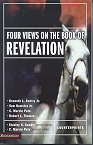
(ed. by Marvin Pate)
Helpful presentation of four approaches to Revelation. Ken Gentry writes the chapter on the preterist approach to Revelation, which provides a 50 page survey of Revelation .
See more study materials at: www.KennethGentry.com
Verses 20-21, which are one sentence in the original, introduces the reason (gar) why the creation waits with such eager expectation. The reason, according to Paul, is that the creation itself was subjected te mataioteti (“to vanity,” KJV). The word mataiotes, while usually meaning “vanity” or “emptiness” as it does in Ecclesiastes (LXX), is better taken as the opposite of telos. The translation “to futility” (NASB) or “to frustration” (NIV) is an attempt to reflect the obvious reference to Gen. 3.17-18 in which the creation by reason of humanity’s sin becomes unable to obtain the goal or fulfill the purpose for which it was created…. The context favors the primary reference to Adam’s sin. The creation was subjected (the aorist points to a specific event—the fall) “not willingly” or through its own fault “but because of Him who subjected it, in hope…” (v. 20). The wording of the sentence is awkward. Dunn recommends that the difficulty arises from Paul’s attempt to explain too briefly a more complex thought: that the creation subjected to humanity in the beginning by God was also subjected to the effects of humanity’s sin.” This remark rejects any hint of an inherently fallen creation but recognizes that due to Adam’s sin the created order became “impaired’ and unable to fulfill its telos.
In view of the Genesis motifs commentators generally that ton hupotaxanta refers to God and affirms that ultimately the plight of creation is due to the divine decree. Paul, moreover, is not detained by the negative perspective but rapidly moves on to a positive message, namely, that the very decree was issued eph elpidi. Amazingly, Paul asserts that the subjection included the element of hope.” Barth roots the hope in the faithfulness “of the one who subjected (no doubt taking eph elpidi as qualifying hupotaxanta, cf. RSV). “Now, He who has subjected the creature is God: and thence emerges hope.” The phrase “in hope” qualifies hupetage as does ekousa and indicates that the very act of subjection included an element of hope. Some have suggested that Paul has in mind the protoevangelium (Gen. 3.15). Thus, hope for the creation was included in God’s promise to humanity even in the beginning. Whatever the specific reference, clearly the subjection of the creation “in hope” was grounded in the understanding of God as creator. The creation always remains under the sovereignty of God, and it is this relationship that brings hope. Notably, that the act of subjection contains a promise of fulfillment affirms a continuity between the old and new creation. God has not given up on his creation. Such language rejects the notion that the present creation may be discarded and replaced by an entirely new one.

Blessed Is He Who Reads: A Primer on the Book of Revelation
By Larry E. Ball
A basic survey of Revelation from an orthodox, evangelical, and Reformed preterist perspective. Ball understands John to be focusing on the destruction of Jerusalem and the temple in AD 70. Insightful. Easy to read.
For more Christian studies see: www.KennethGentry.com
The hope, according to verse 21, consists in freedom from the bondage to corruption characteristic of this age and the freedom of glory enjoyed by the children of God. Paul again unites creation and humanity in their common plight and glorious destiny. This verse provides additional support against the assertion of some that creation’s redemption is contingent upon the freedom of the sons of God. Such a view argues that God has an interest in the deliverance of the created order only as a suitable place for the new humanity. Käsemann presents a more cosmic perspective.
“Since Paul understands eschatological freedom as salvation in a cosmic dimension, he here singularly describes the event of the parousia from the standpoint of anthropology. He could not say that the world was on the way to Christ even though he regarded Christ as the designated cosmocrater and oriented world history to him. He was concerned to show, however, that . . . in the community which suffers with Christ, eschatological freedom as salvation for all creation appears in outline. Hence Christianity; which witnesses to sonship and in the fellowship of suffering points to Christ as the coming Lord of the world, seemed to him to be the great promise for all creation even beyond the human sphere….”
The freedom of the sons of God therefore presents an “outline in miniature” of the greater cosmic salvation of God. One may not think here in terms of concentric circles in which God’s work extends sequentially from believing humanity to the outermost part of the universe. God’s salvation embraces the whole. Humanity’s salvation is indeed a microcosm of the greater macrocosmic event—the redemption of creation. In fact, one could say that the “sons of God’ participate in creation’s redemption. Note also that a continuity between the old and new creation is further attested in Paul’s promise of “freedom’ which clearly implies the idea of transformation rather than annihilation.
Paul continues in logical sequence his argument (gar) in verse 22 which also serves as a summary of the previous three verses by returning to the theme of the longing of creation (v. 19. Paul introduces a well known fact (‘we know’) that every element of creation groans and suffers together until now. The cosmic and eschatological import of this verse is urged by very language. The “pains of childbirth’ reflects apocalyptic motifs of the messianic woes prior to and leading up to the final advent and cosmic transformation (cf. Jub. 23.22-31; Matt. 24.21). The cosmic dimension of this passage as in other apocalyptic texts is therefore evident in the protrayal of the entire creation in labor, as it were, bringing to birth the new age and new creation. The present tense of the verbs connotes an ongoing process moving toward the eschatological nun (‘now’) of salvation which has already taken place in Christ’s work but is yet to be fulfilled. Thus, verse 22 further emphasizes the two age motif so prominent from chapter 5 onwards to portray the cosmos at the very brink of the new age….
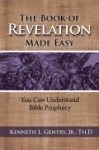
The Book of Revelation Made Easy
(by Ken Gentry)
Helpful introduction to Revelation presenting keys for interpreting. Also provides studies of basic issues in Revelation’s story-line.|
See more study materials at: www.KennethGentry.com
As the distress of creation is a signal that it stands on the verge of salvation so the presence of the Spirit serves as a “pledge’ of eschatological adoption as sons—the redemption of the body (v. 23). That the redemption of the body is mentioned in this context is not surprising. The hope of the new order of salvation for Paul does not entail an immaterial existence. This is clearly traced to the NT understanding of the incarnation and resurrection of Jesus. In fact, the resurrection affirms the importance of all material existence. Regarding creation, Martin affirms that “the resurrection of Jesus blocks forever the idea that God wills to be glorified by the annihilation of biological life on this planet.’ The redemption of creation has often been argued on the basis of the resurrection of the body. Thus, a resurrected body demands a new material creation as a suitable habitat. However, in light of the cosmic scope of this passage, is it not more appropriate to assert that God provides a new body fit for the new creation? [KG: That is, not the corruptible body of the fallen order, but an incorruptible body for the fully redeemed order.]
Paul’s promise of the redemption of creation in Rom. 8.18–23 provides an important witness to God’s cosmic salvific plan and hence to the value of the created order itself. In the present context Paul’s cosmic perspective provides a source of hope for believers who likewise are anxiously waiting the glorious parousia. Indeed, as a part of a macrocosmic-redemptive event believers long not only for the “revealing of the sons of God’ but for the creation’s liberation from bondage. Their confidence in the present “already-not yet’ eschatological existence is in fact based “on the condition of hope’ that they, like all of creation, stand at the brink of glory.
GOODBIRTH AND THE AGES
I am currently researching a technical study on the concept of the Two Ages in Scripture. This study is not only important for understanding the proper biblical concept of the structure of redemptive history. But it is also absolutely essential for fully grasping the significance of the Disciples’ questions in Matthew 24:3, which spark the Olivet Discourse. This book will be the forerunner to a fuller commentary on the Olivet Discourse in Matthew’s comprehensive presentation. This issue must be dealt with before one can seriously delve into the Discourse itself.
If you would like to support me in my research, I invite you to consider giving a tax-deductible contribution to my research and writing ministry: GoodBirth Ministries. Your help is much appreciated!



 Postmillennial Worldview
Leave a comment