
 PMW 2024-086 by Kenneth L. Gentry, Jr.
I recently had a reader, whose name is “AJ,” express his concerns over preterism as presented on my blogsite. His comments were posted about my one-sentence answer to a brief question he asks regarding Revelation 18:3 and the merchants of the earth. Then he responds at length to that one-sentence reply. I will quote his two comments and my replies. Hopefully these will be of interest not only to AJ but to others.
AJ wrote:
“I respectfully have a question I hope you can answer. I have been researching preterism Versus Futurism and have a Litany of questions. But one I would like to ask here would you reference in your aforementioned quote of Revelations Is the merchants who stand Aloft at sea lamenting the destruction of the Great city. I know it goes on to say all of the merchants in Kings of the Earth grew wealthy from her, yet my research into the economic effects of Jerusalem in the first century ad indicate it had a very, very minor role in trade and certainly did not build the wealth of all the merchants and nations of the earth. There were a couple of coastal cities In that region that Much come up much more important for trade, so how can reasonably these verses about Jerusalem making the whole world wealthy be true? Thank you for taking the time to answer my question. God bless you.”
I briefly answered: “The wealth which is especially under view is that of the temple, which had enormous gold stores. These were pillaged by the Romans.” Admittedly, my comment was too brief. But I did not expect a lengthy rejoinder to it. Yet I am glad he wrote back, since I believe he has some issues in his own thinking that needed to be resolved, and that will be helpful for others to consider.
Have We Missed the Second Coming:
A Critique of the Hyper-preterist Error
by Ken Gentry
This book offers a brief introduction, summary, and critique of Hyper-preterism. Don’t let your church and Christian friends be blindfolded to this new error. To be forewarned is to be forearmed.
For more Christian educational materials: www.KennethGentry.com
To this he responded:
End of AJ’s comment/reply.
Why Not Full-Preterism? by Steve Gregg
This work exposes some of the key flaws in Hyperpreterism by someone who has formally debated them. Much insightful material for those who might be tempted to forsake historic Christian orthodoxy.
For more Christian educational materials: www.KennethGentry.com
The orthodox preterist has two main difficulties in today’s theological discussion.
First, preterism is quite different from the dispensationalism which many Americans (such as me!) have grown up in. Thus, it is boggles the mind of those raised in the dispensational framework. Though dispensationalism arose in the 1880s, many American Christians believe it is ancient, historic orthodoxy.
Second, the other problem is the fact that there is a perversion of preterism that has a large presence on the Internet. This view is known as “hyper-preterism,” though its adherent prefer to call it “consistent” preterism or “full” preterism (even though it is neither consistent nor full). When someone stumbles on the orthodox preterist interpretation of certain passages, they oftentimes begin looking around to find out more about the view. Unfortunately, they stumble into one of the many hyper-preterist websites that begin steering them away from genuine historic orthodoxy. The hyper-preterists do not believe in a future bodily return of Christ, a future bodily resurrection of the dead, a future physically restored new heavens and near earth, nor a future final judgment that brings history to an end and establishes the final, eternal, consummate order wherein righteousness dwells.
This leads me to consider AJ’s lengthy response to my one-sentence answer to his previous question. And his response shows his confusion on matters of preterism. I will give his lengthy answer, but only respond to the most relevant portions.
AJ writes:
“Hmmmm. So the Kings and Merchants of the world DIDN’T mourn over the loss of Jerusalem because they weren’t going to get wealthy anymore, they were actually rejoicing that they were getting wealthier upon its destruction? But only the Roman merchants? It just doesn’t fit.
I just want to point out, brother, that it’s very easy, when putting together a puzzle, to take the pieces that don’t quite fit and trim them so they do. But it doesn’t necessarily complete the puzzle, it still leaves more unanswered questions. I think it’s safe to say, and we all know historically, that the merchants and nations of the world did NOT get wealthy from trade with Jerusalem, neither did they mourn over her destruction because they weren’t going to get wealthy any longer. We have to twist and invert parts of the prophesies to make them match because they say the opposite of what actually happened.
Futurism does the same thing, it tries to trim pieces of the puzzle to make it fit when it doesn’t. I think preterism is closer to the actual truth, but there are so many areas still where they have to trim pieces to make it fit. It’s either that, or they have to admit the Bible lied. But seriously, there’s no amount of metaphor or simile or allegory or symbolism that can make those verses appear to say something different. Either the Kings and Merchants of the world got wealthy from Jerusalem and then mourned her destruction, or they didn’t.
There are so many other things that don’t quite fit, like the fact that Satan and his demons were locked away after Jesus resurrection, yet the apostles were performing exorcisms in the book of Acts, so clearly demons were out and about and active.
And the trampling on Jerusalem until the times of the Gentiles are fulfilled, this is supposed to have been only a month, from August 70 AD to September 70 AD? And then the times of the Gentiles were fulfilled? I mean, wasn’t the times of the Gentiles supposed to be after Jews rejected Jesus? Yet Luke 21 seems to indicate that this doesn’t occur until after the Gentiles trample on Jerusalem. So it’s basically only a month.
And one of the biggest pieces I see that doesn’t fit is turning Genesis chapters 1 through 10 into didactic fiction by claiming there was no original sin, that Adam was somehow created evil. This is what I have heard from many preterists. But the fundamental question, then, is why did Jesus come at all? He was a sacrifice for what? If humans were created sinful and humans are still sinful today, why did God need to wait thousands of years to send a sacrifice for something that never happened, original sin? Without original sin, then nothing really changed spiritually after Christ. We’re still the same now as we were before. Christ didn’t need to sacrifice himself if there’s absolutely nothing his blood washes away because we were allegedly created evil anyway.
There are just many questions unanswered and logical inconsistencies, and preterist have as many different interpretations as futurists do. I can see at its core a fundamental truth in preterism, but whenever questions about specifics arise, nobody can answer them satisfactorily. Every time I go to a preterist website or chat room or social media group, they all tell me a little something different. It’s so confusing, I sometimes doubt if any of this is even real.
Can you understand my concerns here? It’s as if whenever something doesn’t fit, we alter so it does. I mean honestly, the treasures that sat inside the temple had not been making the Roman world wealthy such that the kings and the merchants of the Roman world wept when Jerusalem fell. If anything, that scripture makes it sound like Rome is the one that made the kings and merchants of the earth wealthy. Scripture almost sounds as if it’s describing the subsequent fall of Rome after they destroyed Jerusalem.
Are you completely certain that all of Revelation and all prophecy was basically completed in the reign between Nero and Vespacian? There’s no other times for which we’re waiting?”
Thus endeth the quoting of AJ. Now for my (brief!) reply:
First, confusing the good and the bad
AJ, is clearly confusing hyper-preterism and orthodox preterism. And he shows why he does so, for he states toward the end of his lengthy question: “Every time I go to a preterist website or chat room or social media group, they all tell me a little something different. It’s so confusing.” There’s his problem. You must be careful picking up your theology in an on-line “chat room” or “social media group.” You should study noteworthy writers and their sound, peer-reviewed, published documents to get a proper understanding of the matter. He clearly has been reading hyper-preterists and their strange, unorthodox view of “original sin.”
Second, confusing “the merchants of the earth”
His fundamental concern has to do with my arguing that “the merchants of the earth” have to do with the temple economy in pre-70 Jerusalem. This is because he is not aware of my (and others’) understanding of the phrase “the earth” in Revelation. Most often references to “the kings of the earth” or “the merchants of the earth” are not global statements. Rather, I argue in quite some depth in my commentary (and elsewhere) that the Greek phrase translated “the earth,” can be translated as “the Land,” i.e., “the Land of Israel.” And its should be so translated in Revelation 18.
 Why I Left Full-Preterism (by Samuel M. Frost)
Former leader in Full Preterist movement, Samuel M. Frost, gives his testimony and theological reasoning as to why he left the heretical movement. Good warning to others tempted to leave orthodox Christianity.
See more study materials at: KennethGentry.com
Third, confusing the temple’s wealth
He is surprised that I would suggest that the temple’s wealth is in view in Revelation 18. How could little Israel have an (seemingly) world-dominating wealth under the Roman empire? Actually, we find much evidence that Israel’s temple system was surprisingly wealthy. I cannot deal with all the evidence here, but I would cite just a few sentences from my commentary (vol. 2, p. 1417) which provide a taste of the temple’s wealth that is behind John’s imagery:
“These merchants mourn because ino one buys their cargoes any morei (18:11b). Since Israel’s great wealth was tied to her temple, her trade strength depended on the temple. Titus’s speech to the defeated Jews in Jerusalem declared the beneficence of Rome toward the Jews: iWe have given you leave to gather up that tribute which is paid to God with such other gifts that are dedicated to him; nor have we called those that carried these donations to account, nor prohibited them; until at length you became richer than we ourselvesi (J.W. 6:6:2 §335). The temple, its treasures, and its economic benefit were destroyed in AD 70. The Romans iburnt down the treasury chambers [in the iholy housei], in which was an immense [apeiroi, iunmeasurable, countlessi] quantity of money, and an immense number of garments, and other precious goods there deposited; and, to speak all in a few words, there it was that the entire riches of the Jews were heaped up together [pas ho Ioudaion sesoreuto ploutos], while the rich people had there built themselves chambers [to contain such furniture]” (J.W. 6:5:2 §282).”
In conclusion, I urge readers of preterist literature to make sure you distinguish between preterism and hyperpreterism. And also that you carefully study what orthodox preterism actually says before you attempt to critique it.
The Divorce of Israel: A Redemptive-Historical Interpretation of Revelation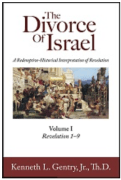
This long-awaited commentary has now been published. It is an 1800 page, two-volume deeply exegetical, academic commentary on the Bible’s most mysterious book.
Click: https://www.kennethgentry.com/the-divorce-of-israel-2-vols-by-gentry-pre-publication-offer/
See more study materials at: www.KennethGentry.com



 Postmillennial Worldview
It helps a lot when preterist interpretation is supported with an explanation of the contemporary history of those times, which is otherwise not known, especially those coming out of dispensationalism.