
 PMW 2024-064 by Kenneth L. Gentry, Jr.
As I continue this study series on 666 and its application to Nero Caesar, we must now note that in the text the Beast is said to “make war with the saints and to overcome them” (Rev. 13:7). In fact, he is said to conduct such blasphemous warfare for a period of 42 months (Rev. 13:5).
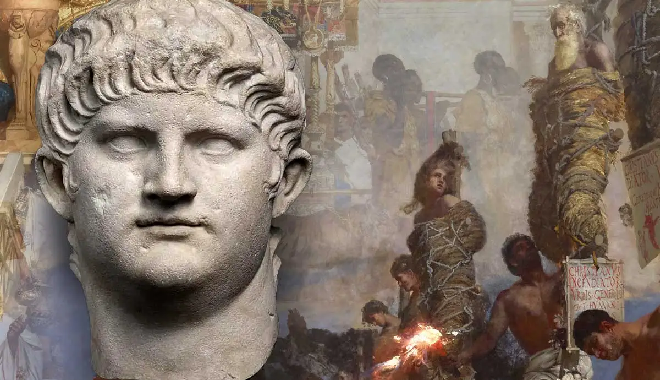
Remarkably, the Neronic persecution of Christianity — the first and one of the most gruesome — lasted almost precisely that length of time. The persecution of Christianity by Nero began in the latter part of November, A.D. 64. It ended with the death of Nero, which occurred on the ninth of June, A.D. 68. [1] But for a few days, this represents a period of almost 42 months! How significant! Not only does Nero’s name fit the number of the Beast, but his persecution lasted the very time required by the Beast’s war against the saints.
The Character of the Beast
In Revelation 13 the one behind the 666 riddle is specifically designated a “beast.” The word for “beast” in Greek is therion, a term frequently used of “wild animals,” of “dangerous animals.” [2] Therion is often used of the wild, carnivorous animals employed in the cruel Roman arenas. [3] Because of its natural association, the term is often quite aptly used figuratively of persons with “a ‘bestial’ nature, beast, monster.” [4]
The Book of Revelation Made Easy
(by Ken Gentry)
Helpful introduction to Revelation presenting keys for interpreting. Also provides studies of basic issues in Revelation’s story-line.|
See more study materials at: www.KennethGentry.com
Now it is almost universally agreed that Nero was one who was possessed of a “bestial nature.” His bestial cruelty is evidenced in the writings of the Roman historian Suetonius.
Suetonius notes that Nero “compelled four hundred senators and six hundred Roman knights, some of whom were well to do and of unblemished reputation, to fight in the arena”. [5] Suetonius also notes that Nero was a sodomist (Nero 28) who is said to have castrated a boy named Sporus and married him (Nero 28, 29). He enjoyed homosexual rape (Nero 28) and torture (Nero 29). He killed his parents, brother, wife, aunt and many others close to him (Nero 33–35).
More particularly for Revelation’s purpose, Nero was the first of the imperial authorities to persecute Christianity, and that with the vilest evil and most horrendous fury. Tacitus records the scene in Rome when the persecution of Christians broke out:
“So, to dispel the report, [Nero] substituted as the guilty persons and inflicted unheard-of punishments on those who, detested for their abominable crimes, were vulgarly called Christians. . . . And their death was aggravated with mockeries, insomuch that, wrapped in the hides of wild beasts, they were torn to pieces by dogs, or fastened to crosses to be set on fire, that when the darkness fell they might be burned to illuminate the night. . . . Whence it came about that, though the victims were guilty and deserved the most exemplary punishment, a sense of pity was aroused by the feeling that they were sacrificed not on the altar of public interest, but to satisfy the cruelty of one man.” [6]
The second century writer, Apollonius of Tyana, specifically called Nero a “beast”:
“In my travels, which have been wider than ever man yet accomplished, I have seen many, many wild beasts of Arabia and India; but this beast, that is commonly called a Tyrant, I know no how many heads it has, nor if it be crooked of claw, and armed with horrible fangs. . . . And of wild beasts you cannot say that they were ever known to eat their own mother, but Nero has gorged himself on this diet.” [7]
In Sibylline Oracles 8:157 (A.D. 175) Nero is fearfully designated a “great beast.”

Blessed Is He Who Reads: A Primer on the Book of Revelation
By Larry E. Ball
A basic survey of Revelation from an orthodox, evangelical, and Reformed preterist perspective. Ball understands John to be focusing on the destruction of Jerusalem and the temple in AD 70. Insightful. Easy to read.
For more Christian studies see: www.KennethGentry.com
The fourth century Christian writer Lactantius, speaks of him as “an execrable and pernicious tyrant” and a “noxious wild beast.” [8] The fourth century church historian Eusebius writes of him as one possessed of “extraordinary madness, under the influence of which, [he] . . . accomplished the destruction of so many myriads without any reason.” [9]
NOTES
1. Moses Stuart, Commentary on the Apocalypse (Andover: Allen, Morrill and Wardwell, 1845), 2:469. See also: Justo L. Gonzalez, The Early Church to the Dawn of the Reformation (San Francisco: Harper and Row, 1984), 36.
2. Arndt-Gingrich, Lexicon, p. 361. In Lev. 26:6 the beasts of the land are symbolic of evil; in Lev. 26:22 God promises their return to plague Israel and to bereave her of her children if she is unfaithful to the covenant. Messianic blessedness vanquishes the evil beasts (Isa. 11:6-9; Eze. 34:25).
3. Josephus, Wars, 7:38; Martyrdom of Polycarp, 2:4; 3ff.; 11:1ff; Ignatius, Romans 4:1ff; 5:3; Smyrnaens 4:2; Diognetus 7:7; Hermas, Visions 3:2:1.
4. Arndt-Gingrich, Lexicon, 361.
5. Nero 12.
6. Annals 15:44.
7. Philostratus, Life of Apollonius 4:38.
8. Lactantius, Of the Manner in Which the Persecutors Died, 3 (see: ANF 7:302).
9. Eusebius, Ecclesiastical History, 2:25:2.



 Postmillennial Worldview
You’ve adeptly proven that Nero is a good fit as the beast of Revelation from every standpoint so far.