
PMW 2024-060 by Kenneth L. Gentry, Jr.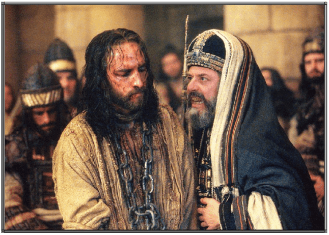
As we near the end of Matthew’s Gospel, we see further evidence of the Jewish rejection of the Messiah and evidence of Gentile inclusion in the people of God. Once again, this helps justify the Olivet Discourse given just a day or so earlier.
In Matthew 26:3–5 Israel’s chief priests and elders along with the high priest counsel Jesus’ death. They begin implementing their evil plan in verses 14–15 where they pay Judas to betray Jesus to them (cp. vv. 21–25, 45). But once again we find another indicator of Gentile inclusion: “Truly I say to you, wherever this gospel is preached in the whole world, what this woman has done will also be spoken of in memory of her” (v. 13).
In Matthew 26:47 the “chief priests and elders of the people” come with Judas to arrest Jesus. The Lord rebukes Peter for taking up a sword to defend him by warning: “Put your sword back into its place; for all those who take up the sword shall perish by the sword” (v. 52). This instructs the disciples that such actions are incompatible with his message (cp. 5:39–42) and against God’s will for his death (26:2, 53–54; John 18:11). But it also probably warns of what will befall Israel as they take up the sword against Rome in AD 66. The violent Jewish reaction to Rome eventually leads to the full-scale Jewish War that destroys Jerusalem and the temple (AD 67–70). Jesus warns of this earlier in Matthew 10:34 (cf. 10:23; cp Luke 22:36–38).

Postmillennialism Made Easy (by Ken Gentry)
Basic introduction to postmillennialism. Presents the essence of the postmillennial argument and answers the leading objections. And all in a succinct, introductory fashion.
See more study materials at: www.KennethGentry.com
In Matthew 26:57 the party arresting Jesus hauls him before Israel’s highest court, a meeting of the Sanhedrin, which consists of the high priest, scribes, and elders. There he undergoes a trial before the high priest who even attempts to present false witnesses against him (v. 59). Prominent in his trail are the reports of his denouncing the temple, though his words are twisted by false-witnesses: “This man stated, ‘I am able to destroy the temple of God and to rebuild it in three days’” (26:61; 27:40; cf. John 2:19).
In Matthew 26:64 Jesus warns that the high priest himself, along with the Sanhedrin, will see him coming in cloud-judgment against them: “Jesus said to him [auto, sing.], ‘You [su, sing.] have said it yourself; nevertheless I tell you [humin, pl.], hereafter you shall see [opsesthe, pl.] the Son of Man sitting at the right hand of Power, and coming on the clouds of heaven.’”
 Political Issues Made Easy
by Kenneth Gentry
Christian principles applied to practical political issues, including the importance of borders, the biblical warrant for “lesser-of-evils” voting, and more. A manual to help establish a fundamentally biblical approach to politics. Impressively thorough yet concise.
See more study materials at: www.KennethGentry.com
France well captures the meaning and significance of this statement:
“The ‘coming on the clouds of heaven’ cannot be read as a reference to the parousia, as has been the traditional exegesis until relatively recently. See on 24:30 for a parallel issue, where exactly the same words are used … with reference … to the enthronement of the Son of Man in contrast to the destruction of the temple. There the event predicted was to take place within ‘this generation’ [cf. Matt. 24:34], and here, too, Matthew’s wording demands a fulfillment which is imminent rather than set in the indefinite future: it is something which ‘you’ (the current Sanhedrin members) ‘will see,’ and it will come true ‘from now on’ . . . . In the vindication of the repudiated Messiah and in the powerful growth of the movement which they have attempted to suppress, they ‘will see’ that it is he who is now seated on the heavenly throne.” (France, Matthew (NICNT), 1027–28)
I would note that the NASB’s “hereafter” is based on the Greek ap arti, which is literally translated “from now,” which means “from this point in time.” In Matthew 26:65 the high priest declares that Jesus blasphemes, and as a consequence he tears his high-priestly robes. He intends this to signify his judgment against Jesus. But it is included in the text not only to signify God’s judgment of the high priest, but it also prefigures the coming rending of the temple veil (Matt. 27:51) at Jesus’ death on the cross. The rending of the veil is mentioned only in Matthew’s Gospel. Both of these actions point to the ultimate destruction of the temple. Then the Sanhedrin spit on him and beat, slap, and taunt him (26:67–68).
Click on the following images for more information on these studies:
 |
 |
 |



 Postmillennial Worldview
Leave a comment