
PMW 2023-058 by Kenneth L. Gentry, Jr. 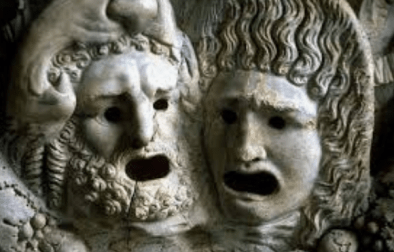
In this short series I will be providing insights into John’s method of presenting his material in Revelation. My commentary on Revelation should be out this Fall. [1] It will be titled: The Divorce of Israel: A Redemptive-historical Approach to Revelation. Thus, I understand Revelation as involving God’s divorcing of Israel as his (old covenant) wife as he takes a new bride (the new covenant church).
I will build the case for Revelation as a drama involving God’s relationship to Israel in this three-part series. So, let us begin by noting that it is presented as a drama.
Scholarly Notices
A growing number of scholars suggest that “the basic format of the book — a pageant of visions — draws on the theatrical model of a succession of scenes” (DBI 714). For instance, Smalley (1994: 105) suggests that “if we interpret the Apocalypse in its entirety as a drama, this is, given the nature of John’s material, a natural and uncomplicated exercise. Revelation lends itself to such an interpretation.”
In fact, many scholars recognize not only that “theatrical motifs and imagery pervade the book,” but that this “may show signs of influence from the conventions of classical drama” with its many scene changes (DBI, 714; cp. Wilcox 15–18; Smalley 109). Though John is a devout Jew, he is doing what other Jewish writers do after the third century BC, for “Jewish authors experimented with Greek genres — epic, tragedy,” and so forth (EDEJ 17).
Stage Issues
Revelation’s four most basic scene changes involve John’s in-Spirit experiences (see: 1:10; 4:2; 17:3; 21:20). John seems even to borrow “from the known setup of the Greco-Roman stage” with many “prop changes” such as the golden lampstands (ch 1), God’s throne (ch 4), the altars (ch 8), the ark of the covenant (ch 11), the sanctuary (chs 15–17), and the church enthroned (ch 20) (IBD 4:63). Consequently, he “was clearly heir to two cultural traditions — the Hebrew-Christian and the Greco-Roman — upon both of which he unhesitatingly drew” (IBD 4:62).
Navigating the Book of Revelation (by Ken Gentry)
Technical studies on key issues in Revelation, including the seven-sealed scroll, the cast out temple, Jewish persecution of Christianity, the Babylonian Harlot, and more.
See more study materials at: www.KennethGentry.com
That Revelation is addressed to Christians in Asia Minor (rather than in Judea) may explain this approach, for this area is highly Romanized, noted for its wealth, and filled with imperial temples with their dramatic cult worship. It is certainly true that “Greek drama was in flower in Ephesus in the days of the Apostle John” (Pieters 104). Thus, John can frame his work in this manner in that his original “audience would have been . . . knowledgeable about Greco-Roman culture, in which they lived” (Royalty 18). After all, most scholars agree that John carefully aims his work to the real-life situations of his first-century audience in Asia Minor (1:4, 11; 2–3) so that he may be understood (1:3) (cf. Ramsay; Hemer; Worth).
A Qualification
I must qualify this observation, however. For while many scholars view Revelation as a drama, “none of them thinks that it was actually intended for performance in a theater” (Wainwright 143). Furthermore, it is not designed to be an acted drama, but an oral one “meant to be heard by the audience” (Witherington, 16; cp. Royalty, 127). Kirby (198) points out that “though the Revelation is a literary text, it nonetheless takes the form of a text intended ot be presented orally to an audience.” Thus, as Sandy (2002: 127) notes “hearing was precisely the way the first hearers received the message of the Apocalypse. . . . Hearing the Apocalypse enacted orally in one sitting gives hearers a distinctive sense of the message of the book.”
Thus, the blessing for reading and hearing it (1:3) is not only due to the practical means for accessing Revelation before printing presses made book production affordable. Rather John expressly designs its very language and structure for oral performance (Bauckham 1993a: 2; Barr 1986). Yet even still, we should not think that John intends Revelation to be a traveling production making its way through the big-city circuit for paid theatrical performance. It is more of a what we might call a “‘parlor’ drama to be read in private or at public assembly of a local church” (IBD 4:59).
Stage Props
Given Revelation’s extremely Jewish character, its abundant OT allusions, and its overarching Judaic-judgment theme, we should note that “the stage props for every act in this drama are adapted from the tabernacle and temple” (Bowman 25). Indeed, in Revelation “the theme of the Temple is of such great importance that it could be termed the ‘organizing principle’ of the text as a whole” (Ben-Daniel 4). John mentions the central sanctuary of the temple sixteen times (3:12; 7:14; 11:1, 2, 19; 14:15, 17; 15:5, 6, 8; 16:1, 17; 21:22). We also read of the outer court (11:2), the altar (11:1), the altar of sacrifice (6:9), the altar of incense (8:2, 4; 9:13; 14:18; 16:7), the golden lampstand (1:12, 13, 20; 2:1, 5; 11:4), harps (5:8; 14:2; 15:2), trumpets (chs 8–11), and libation bowls (chs 15–16).
Dramatic Orality
Fiorenza (1998: 22) speaks of “the evocative power and ‘musicality’ of its language, which was written to be read aloud and to be heard.” She (160) later notes that “the hearer of the text is impressed by its rhythmic and archaic language, by the repetition of sounds and words, and by the wealth of colors, voices, symbols, and image associations.” Once again reflecting the wider OT backdrop of Revelation, Safrai and Stern (1012) point out that the Hebrew prophets themselves tend to reflect Hebrew poetry’s archaic grammatical forms. The very sounds of some of John’s evocative words and expressions are designed for their emotive impact. In the original language, his word sounds, sentence cadence, and so forth heighten the dramatic effect. As a consequence, “reading the Apocalypse aloud, and hearing the Apocalypse read aloud, was effectual” (Callahan 1995: 460).
Survey of the Book of Revelation
(DVDs by Ken Gentry)
Twenty-four careful, down-to-earth lectures provide a basic introduction to and survey of the entire Book of Revelation. Professionally produced lectures of 30-35 minutes length.
See more study materials at: www.KennethGentry.com
What is more, “the people who first heard John’s Apocalypse and the other writings of the New Testament were able to perform and make sense of complex, sophisticated, and subtle oral presentations, especially stories. These performances appealed not merely to the eyes and ears but, as the Apocalypse itself demonstrates, to the visual, tactile, olfactory, and gustatory senses. Revelation was meant to be experienced as a whole” (Saunders 2003:123). Indeed, John’s work is so powerful that even he himself responds emotionally as he is caught up in it: he faints (1:17), weeps (5:4–5), becomes sick (10:10), is surprised (17:6–7), gets confused (19:10; 22:9), and so forth. Revelation is high-order, nerve-shattering oral drama.
Given the divine judgment theme of John’s drama, we repeatedly hear loud noises such as crashing thunder (4:5; 8:5; 10:3; 11:19; 16:18; 19:6) and booming voices (1:10, 15; 4:1; 5:2, 11–12; 6:1, 10; 7:2, 10; 8:13; 10:3; 11:12; 12:10; 14:2, 7, 9, 15, 18; 16:1, 17; 18:2; 19:1, 5, 17; 21:3). Resounding throughout are the weeping and mourning of the doomed (1:7; 18:9, 11, 15, 18–19), blaring trumpets (1:10; 4:1; 8:2, 6, 13; 9:14; 18:22), loud heavenly voices (5:11, 13; 6:1, 3, 5–7; 8:13; 9:13; 10:4, 8; 11:12; 12:10; 14:13; 16:1, 5, 7; 18:4; 19:1; 21:3; 22:17), the voices of multitudes (7:4; 19:6), the roar of rushing water (1:15; 14:2; 19:6), and various other sounds (e.g., 8:5; 9:9; 11:19; 16:18). And we can imagine the groaning sound of earthquakes (6:12; 8:5; 11:13; 16:18).
We can also hear what Scripture elsewhere calls “the sound of an army camp” (Eze 1:24), “a sound of chariots and a sound of horses” (2Ki 7:6), for in Revelation we read of: “the sound of chariots, of many horses rushing to battle (9:9) with the pounding of horse hooves (6:2–8; 9:7, 9, 16) and the clashing of swords (6:4, 8; 13:10). John even uses a dramatic silence amidst it all to accentuate the drama (8:1), and laments the lack of joyful sounds (18:22).
Resseguie (20) well observes that “Revelation is the ‘noisiest book’ in the New Testament” (cp. Smalley 211). Maier (91) cleverly comments: “The Apocalypse is the New Testament’s noisiest book. Playing with the popular misnomer, we might rename it the Book of Reverberations.” He continues: “in the ‘oral sensorium’ of the Apocalypse, as in other oral cultures, sounded words are enchantingly powerful” (Maier 96). Barr (1986: 243, 250) is surely correct: “The orality of the Apocalypse is an essential element of its hermeneutic. The original audience encountered it as an aural experience,” so that “this was surely a work intended for repeated performances.” This should not surprise in that, as Schlesinger (2008: 6) notes while citing D. Rhoads: “the overwhelming majority of the first century Christians (perhaps 95%) experienced their traditions — including gospels, letter, and apocalypses — only in some form of oral performance.”
As I will demonstrate throughout my forthcoming commentary, Revelation is mainly focusing on the soon-coming Jewish War with Rome and the destruction of her capital city and its beloved temple. And the sounds of that awful war are terrifying. Josephus even mentions them as one dramatic aspect of Israel’s woes and terror:
“The flame was also carried a long way, and made an echo, together with the groans of those that were slain; and because this hill was high, and the works at the temple were very great, one would have thought the whole city had been on fire. Nor can one imagine any thing either greater or more terrible than this noise; for there was at once a shout of the Roman legions, who were marching all together, and a sad clamor of the seditious, who were now surrounded with fire and sword. The people also that were left above were beaten back upon the enemy, and under a great consternation, and made sad moans at the calamity they were under; the multitude also that was in the city joined in this outcry with those that were upon the hill. And besides, many of those that were worn away by the famine, and their mouths almost closed, when they saw the fire of the holy house, they exerted their utmost strength, and brake out into groans and outcries again: Perea did also return the echo, as well as the mountains round about [the city,] and augmented the force of the entire noise.” (J.W. 6:5:1 §272–74)
“Now the trumpeters of the several Roman legions sounded together, and the army made a terrible shout; and the darts, as by order, flew so last, that they intercepted the light. However, Josephus’s men remembered the charges he had given them, they stopped their ears at the sounds.” (J.W. 3:7:27 §265–66)
“They then poured in over the parts of the wall that were thrown down, with a mighty sound of trumpets and noise of armor, and with a shout of the soldiers, and brake in by force upon those that were in the city.” (J.W. 4:1:4 §20)
Not only so but explanatory hymns appear at critical junctures in the visions to show that “the Apocalypse of John rests on the Greek’s symmetrical, theatrical, and dramatic performance — and hymns constitute a critical component in the narrative, theology plot” (Letseli 3). And just as hymns are an important component of Greek drama and imperial worship, Revelation’s “hymns clearly comment on and complement the visions and auditions of the book . . . and function as a sort of divine commentary, rather like a court reporter putting things in perspective” (Witherington 19). Filho (2002: 214) agrees noting that “its cultic terminology . . . shows the book has a liturgical interpretive framework.” Indeed, “most of the hymn and hymnic fragments in Revelation are placed in these literary settings” (Aune 1:xcvii). See they hymns of praise in 4:8, 11; 5:9–10, 12, 13; 7:10–12 ;11:5, 17–18; 12:10–12; 15:3–4; 16:5–7; and 19:1–8. This is true also in the well-known emperor-cult temple ritual in Asia Minor, for “hymn singing . . . represented a standard component of the worship” (Worth 1999a: 122).
Not only does John present us with an oral drama, but there is more. But next time!
NOTE
1. It should be in supermarkets by September. It will be in the kindling section next to the lighter fluid.



 Postmillennial Worldview
Certainly an interesting way to view Revelation, as drama. I can relate to that when one filters all the dramatic words that colour Revelation. One thing that catches my attention when Revelation is discussed is that Josephus is without exception always raised, and the most quoted individual by Preterists. I understand why that is, but it does concern me the Josephus takes centre stage so much it is as if he becomes more important to Preterists and their thinking, than the Holy Scripture itself. No doubt I will be told I am misguided, but think about it, at least for a moment, at intermission.
The very nature of the case virtually demands reference to Josephus. Preterism claims that certain notable NT prophecies regarding the temple were fulfilled in the AD destruction of the temple. If we make that biblical claim (which we do), it would be quite remarkable if we could not point to any past historical fact that demonstrates our interpretation of Scripture.
“it is not designed to be an acted drama” – still, I think it would be great if a narrator read Revelation, maybe modified to reproduce as much as possible the rhythm and repetition of the original Greek, with digital projections of scenes behind the narrator and sounds from the events being described.
If your goal here is to “re”wet out appetites for your LONG-waited Revelation commentary, you have succeeded mightily.
By having my commentary continually delayed, I am sure it did “wet” your appetite by throwing cold water on it. But hopefully now I can “whet” your appetite by declaring the time is at hand! 😉