
 PMW 2023-046 by Kenneth L. Gentry, Jr.
This is the third and final installment in this three-part series. If you want anymore installments, you will have to write them yourself. I am weary because I have been up late worrying about next week. I told me wife that I finally decided that I want to be cremated. She immediately went out and got me an appointment for next Tuesday. How do I get in these messes? [1]
CHRIST AND THE POSTMILLENNIAL HOPE
In Christ’s earthly ministry we witness the coming of the prophesied kingdom. For instance, in Mark 1:15 we hear the Lord himself proclaim: “The time is fulfilled, and the kingdom of God is at hand; repent and believe in the gospel.” Thus, not only does he declare that “the” time is fulfilled (the prophetically-expected time) and that the “kingdom of God is at hand,” but he also associates it with the proclamation of the gospel. Later in Matthew 12:28 we read him state: “if I cast out demons by the Spirit of God, then the kingdom of God has come upon you.”
This is why we hear of the early Christians being charged with preaching another king (Acts 17:7). This is why Paul informs the Colossians that “He rescued us from the domain of darkness, and transferred us to the kingdom of His beloved Son” (Col 1:13). This is why John can say in Revelation: “He has made us to be a kingdom, priests to His God and Father — to Him be the glory and the dominion forever and ever” (Rev 1:6). [2]
Thine Is the Kingdom
(ed. by Ken Gentry)
Contributors lay the scriptural foundation for a biblically-based, hope-filled postmillennial eschatology, while showing what it means to be postmillennial in the real world.
See more study materials at: www.KennethGentry.com
But I want to focus on the Lord’s powerful statement in John 12:31–32: “Now judgment is upon this world; now the ruler of this world will be cast out. And I, if I am lifted up from the earth, will draw all men to Myself.” This sort of statement is exactly what the postmillennialist would expect to hear from Christ.
Let’s note first:
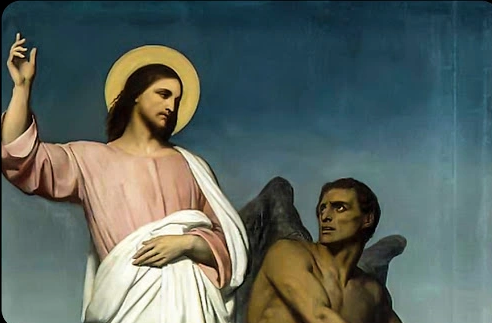
Christ’s dethronement of Satan
As Jesus faces the cross he declares his judgment of the fallen, rebellious world system. Through the horror of the cross he sees the glory of victory. He soon will “cast out” Satan as “the ruler of this world” (John 12:31). What does this mean? Obviously it does not mean Satan is totally removed from any influence in the world, for we see later references to Satan operating in the world.
To understand this statement in its redemptive-historical context we must understand that before the coming and victory of Christ, all the nations of the world except for little Israel were under
the dominion of Satan. In Psalm 147:19–20 we read: “He declares His words to Jacob, / His statutes and His ordinances to Israel. / He has not dealt thus with any nation; / And as for His ordinances, they have not known them.” Similarly in Amost3:2a we read: “You only have I chosen among all the families of the earth.” Therefore Satan could legitimately say to Christ when he offered him “the kingdoms of the world” (Luke 4:5b): “I will give You all this domain and its glory; for it has been handed over to me, and I give it to whomever I wish” (Luke 5:6).
But now Christ declares to his people while standing in the shadow of the cross: “now judgment is upon this world; now the ruler of this world will be cast out.” This dramatic reality appears frequently in the New Testament record. Consider the following three samples of Christ’s victory over Satan:
“But if I cast out demons by the Spirit of God, then the kingdom of God has come upon you. Or how can anyone enter the strong man’s house and carry off his property, unless he first binds the strong man? And then he will plunder his house.” (Matt 12:28–29)
“When He had disarmed the rulers and authorities, He made a public display of them, having triumphed over them through Him.” (Col 2:15)
“Therefore, since the children share in flesh and blood, He Himself likewise also partook of the same, that through death He might render powerless him who had the power of death, that is, the devil” (Heb 2:14)
“The Son of God appeared for this purpose, to destroy the works of the devil” (1 John 3:8)
Three Views on the Millennium and Beyond
(ed. by Darrell Bock)
Presents three views on the millennium: progressive dispensationalist, amillennialist, and reconstructionist postmillennialist viewpoints. Includes separate responses to each view. Ken Gentry provides the postmillennial contribution.
See more study materials at: www.KennethGentry.com
This is why we notice that some New Testament passages referring to Satan show his curtailed influence in the presence of the Christian faith:
“Taking up the shield of faith with which you will be able to extinguish all the flaming arrows of the evil one.” (Eph 6:17)
“The God of peace will soon crush Satan under your feet.” (Rom 16:20)
“Submit therefore to God. Resist the devil and he will flee from you.” (Jms 4:7)
“Be of sober spirit, be on the alert. Your adversary, the devil, prowls around like a roaring lion, seeking someone to devour. But resist him, firm in your faith.” (1 Pet 5:7–8a)
This can only be because of Christ’s casting out of Satan, his binding his power. And this leads to the ultimate result of Satan’s being cast out:
Christ’s enthronement over men
The Lord defeats Satan so that he is no longer able to dominate the world. The result is that Christ himself will “draw all men to Myself” (John 12:32b).
Notice that profound nature of this declaration. He states that if he is “lifted up” (on the cross, John 12:33) that he will draw “all” men to himself. Not some. Not just Jews. Surely not just a remnant. He is not plucking brands from the fire. Rather he is declaring that he will draw the great mass of men to himself.
Christ’s kingdom will grow with more and more conversions. Daniel speaks of the kingdom’s coming in Christ during the Roman empire. He states that it will come as a “stone” (Dan 2:45) but that it will become “a great mountain” that fills “the whole earth” (Dan 2:35). Ezekiel sees its gracious influence trickling from the altar in God’s house (Eze 47:1). But it grows to ever greater depths (Eze 47:3-4) until “it was a river that I could not ford, for the water had risen, enough water to swim in, a river that could not be forded.”
Jesus declares this gradualistic advance of his kingdom by comparing it to a mustard seed and to leaven. “He presented another parable to them, saying, ‘The kingdom of heaven is like a mustard seed, which a man took and sowed in his field; and this is smaller than all other seeds, but when it is full grown, it is larger than the garden plants and becomes a tree, so that the birds of the air come and nest in its branches.’ He spoke another parable to them, ‘The kingdom of heaven is like leaven, which a woman took and hid in three pecks of flour until it was all leavened’” (Matt 13:31–33).
Christ’s kingdom is a living principle. It carries within it a growth tendency. Indeed, it will tend to grown until it draws “all men” to Christ (John 12:32). Thus, as John puts it elsewhere: “For God did not send the Son into the world to judge the world, but that the world might be saved through Him” (John 3:17).
But I must hurry on, and just very briefly consider:
PAUL AND THE POSTMILLENNIAL HOPE
In 1 Corinthians 15:20–27 we discover a Pauline statement that vigorously declares Christ’s kingdom victory in the present era.
1 Corinthians 15:22–24 reads: “For as in Adam all die, so also in Christ all will be made alive. But each in his own order: Christ the first fruits, after that those who are Christ’s at His coming, then comes the end.” [3] This verse contradicts premillennialism in teaching that the resurrection of believers is the finale of history, not the initiation of a new 1000 year period. The resurrection punctuates the end; no new era follows — and certainly no millennium.
In 1 Corinthians 15:24 Paul makes a statement that rebuts the amillennial position: “then comes the end, when He hands over the kingdom to the God and Father, when He has abolished all rule and all authority and power.” Here he notes that when the end comes “He hands over the kingdom to the God and Father.” But he also observes that this end will not come until after he has “abolished all rule and all authority and power.”
The Greek here is important. The NASB translates the pertinent phrase as: “when he has abolished.” But the NIV and ESV offer better translations: “after he has abolished.” In the Greek text the hotan is followed by the aorist subjunctive, katargēsē. Such a construction indicates that the action of the subordinate clause precedes the action of the main clause. [4]
Thus, the end will not come until after Christ abolishes all rule and authority. This is not only grammatically necessary, but contextually. The next verse continues: “For He must reign until He has put all His enemies under His feet” (1 Cor 15:25). That is, he is currently reigning and must continue to reign until all of his enemies are vanquished.
CONCLUSION
This is the postmillennial hope. As Isaiah put it “Now it will come about that In the last days / The mountain of the house of the LORD / Will be established as the chief of the mountains, / And will be raised above the hills; / And all the nations will stream to it. / And many peoples will come and say, / ‘Come, let us go up to the mountain of the LORD’” (Isa 2:2–3).
As Christ expresses it as he approaches the cross: “Now judgment is upon this world; now the ruler of this world will be cast out. And I, if I am lifted up from the earth, will draw all men to Myself” (John 12:31–32).
As Paul declares: “But each in his own order: Christ the first fruits, after that those who are Christ’s at His coming, then comes the end, when He hands over the kingdom to the God and Father, when He has abolished all rule and all authority and power. For He must reign until He has put all His enemies under His feet” (1 Cor 15:23–25).
NOTES
1. This is a joke. I will not be cremated. On purpose.
2. For other kingdom verses see: Acts 8:12; 14:22; 19:8; 20:25; 28:23, 31; Rom 14:17; 1 Cor 4:20; 6:9–10; 15:50; Gal 5:21; Eph 5:5; Col 1:13; 4:11; 1 Thess 2:12; 2 Thess 1:5; 2Ti 4:1; 4:18; Heb 1:8; 12:28; Jms 2:5; 2 Pet 1:11.
3. For a discussion of the Greek word tagma (“turn”), see: Benjamin B. Warfield, Biblical and Theological Studies (Philadelphia: Presbyterian and Reformed, rep. 1952), 484.
4. BAGD, 731.

THE TWO AGES AND OLIVET (advertisement)
I am currently researching a study of the Two-Age structure of redemptive history. My starting point is based on the disciples’ questions to Jesus in Matthew 24:3. Much confusion reigns among those unacquainted with the Two-Age analysis of history, which was promoted by Jesus (Matt. 12:32; Mark 10:29-30) and by Paul (Gal. 1:4; Eph. 1:21). The Two Ages are not the old covenant and the new covenant, but world history since the fall and the consummate order following the Second Coming and the Final Judgment.
If you would like to support me in my research, I invite you to consider giving a tax-deductible contribution to my research and writing ministry: GoodBirth Ministries. Your help is much appreciated!



 Postmillennial Worldview
Similarly in Amost3:2a we read: “You only have I chosen among all the families of the earth.”
This should be
Similarly in Amos 3:2a…
Thank you again Dr. Gentry for a very well written 3 part series on this subject.. As always very clear and accurate Bible teaching … I have enjoyed so many of your works and learned so much… But … I am ( as I’m sure you are ) getting more than impatient waiting for your work THE DIVORCE OF ISRAEL … So looking forward to reading this work of yours !
Me too!
Thanks
Thank you for your weekly articles, I do enjoy reading them as I continue to learn a lot about the variety of views. Not only that, I do enjoy your style of writing with a good mix of commentary and actual scripture. Yes, Christ reigns today at the right hand of the Father and will continue to reign on earth throughout the Millennium (in my humble opinion) until the last enemy death is destroyed per Rev 20:14 in the lake of fire. Then there will be no more death. It is complete. Today we still continue to see death even though we have victory over it through the finished work of Christ. As I learn a little more about the purpose of the Millennium it solidifies my faith about its purpose. I think the LORD, in ruling the nations with an iron sceptre in the Millennium is making his point very clear to all who live and breath, that He has been right all along, and will be justified. All nations will realise it as they are governed by Christ over the thousand year period. Then the eternal state comes thereafter. Today the nations rage against God and accuse him. And rather than immediately consuming all rebellious nations at His second coming, He show His rule over them, then consummates all of heaven and earth. I find in these steps justice is done. To Him be glory, the only true and wise God. Just my two cents, and I thank you very much.