
 PMT 2015-077 by Kenneth L. Gentry, Jr.
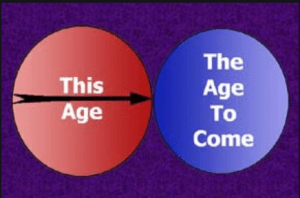
An important eschatological issue involves the New Testament principle of “this age” and “the age to come.” Christ himself speaks of “this age” and another “age to come” (Mt 12:32; Mk 10:30; Lk 18:30; 20:34–35). The present age is sin-laden present in which we live. The “age to come” brings eternal life of the eternal order (Lk 18:30); it involves resurrection and will not include marrying (Lk 20:34–35). It is truly consummate and final.
From the linear perspective of the Old Testament, ancient Israel believes that the “age to come” will be the Messianic era that would fully arrive after their current age ends. Yet in the New Testament we learn that the “age to come” begins in principle with the first century coming of Christ. It overlaps with “this age” which begins in Christ. Thus, we are not only children of “this age” (present, sin-laden temporal history), but are also spiritually children of “the age to come” (the final, perfected eternal age). We have our feet in both worlds. Or as Geerhardus Vos put it: “The age to come was perceived to bear in its womb another age to come.”
Because of this principle, we already share in the benefits of “the age to come.” This is because the two ages are linked by Christ’s ruling in both, for he has a name “far above all rule and authority and power and dominion, and every name that is named, not only in this age, but also in the one to come” (Eph 1:21). Therefore, we have already “tasted the good word of God and the powers of the age to come” (Heb 6:5), despite living in “this present evil age” (Gal 1:4).
The Truth about Postmillennialism
A group Bible study guide for explaining the optimistic prophetic hope for this world to be accomplished before Christ’s Second Coming. Establishes the postmillennial system in both the Old and New Testaments. Touches on key eschatological issues, such as creation, covenant, interpretive methodolgy, the great tribulation, the Book of Revelation, the Jewish Temple, and more. It presents and answers the leading objections to postmillennialism.Twelve chapters are ideal for one quarter of Sunday School.
See more study materials at: www.KennethGentry.com
http://www.kennethgentry.com/the-truth-about-postmillennialism-by-gentry-new-1-10-2020/
We already experience resurrection — spiritually (Jn 5:24–25; Ro 6:4; Eph 2:6; 1Jn 3:14), though we look forward to a physical resurrection beyond “this present time” (Ro 8:18–23). Indeed, we even now sit “with Him in heavenly places” so that “in the ages to come He might show the surpassing riches of his grace in kindness toward us in Christ Jesus” (Eph 2:6b–7). We already partake of the “new creation” (2Co 5:17; Gal 6:15), though the eternal new creation still awaits us (2Pe 3:13). The shaking of the earth and splitting of rocks at Christ’s death (Mt 27:50–51) signal “that Christ’s death was the beginning of the end of the old creation and the inauguration of a new creation” (G. K. Beale).
We already enjoy the “new birth” into that new world (Jn 3:3; 1Pe 1:1, 23), though we will experience the fulness of “the glory of the children of God” only in the future (Ro 8:19, 23). We already possess the Spirit, who is the one who in that future age will “give life to your mortal bodies” (Ro 8:11). We already have victory over Satan (Mt 12:29; Ro 16:20; Jas 4:7), though he is the “god of this age” (2Co 4:4). We do good works now so that we might store up treasure “for the future” (1Ti 6:17–19; cp. Ro 2:5–7).
The central principle uniting “this age” and “the age to come” is the resurrection. Gaffin well states: “The unity of the resurrection of Christ and the resurrection of believers is such that the latter consists of two episodes in the experience of the individual believer — one which is already past, already realized, and one which is future, yet to be realized,” so that our “resurrection is both already and not yet” (Richard Gaffin). Two worlds co-exist in us through the Holy Spirit (Geerhardus Vos). Thus, the “last days” are unique in involving a merger of “this age” and the “age to come” as an “already / not yet” phenomenon. Truly, “Christ’s life, and especially death and resurrection through the Spirit, launched the end-time new creation for God’s glory” (G. K. Beale).
 Why I Left Full-Preterism (by Samuel M. Frost)
Former leader in Full Preterist movement, Samuel M. Frost, gives his testimony and theological reasoning as to why he left the heretical movement. Good warning to others tempted to leave orthodox Christianity.
See more study materials at: KennethGentry.com
Tagged: age to come, ages, present age



 Postmillennial Worldview
Thank you for this post. I’ve actually wondered quite a bit about this as well. I know that amillennialists will use the this/that world idea to disprove both pre- and postmillennialism. I agree that the concept completely refutes the premillennial idea because there is no time period in the bible where resurrected saints co-habit with “regular” sinful people. Also, upon thinking more about the parable of the wheat and the tares in Matthew 13, it seems to me that the parable is describing that the wheat and tares are indistinguishable in their young stages but are easily distinguishable at harvest time. Perhaps this parable is stating not that wickedness and righteousness will “grow together” in quantity, but that both the wheat and tares will mature to the point where they are easily separated one from the other at harvest time, or the end of the world. We see this in Revelation 20 when Satan is loosed to deceive the nations. The wheat/tares parable seems to reflect the truth of the already/not yet concept as well. Thank you for this information!
Hi Dr. Gentry,
Thanks for referring me to this post. As I see it, this is different from Doug Wilson’s idea of “this age” where it is equal to “judaic aeon” that has already terminated during the 70 A.D. Is this right?
There is no “old covenant age.” There is the old covenant era, just as there is the Adamic era, Noahic era, Abrahamic, and so forth.
When Jesus talks of the two ages (“this age” and “the age to come”) he is talking about world history since Adam (“this present evil age”) which is contrasted with “the age to come” (the eternal, consummate new earth after the resurrection when sin has been eradicated from the world).
Thus, blasphemy against the Holy Spirit will not be forgiven in history (“this age”) or in eternity. (“the age to come”). It is truly the unpardonable sin (Matt. 12:32). Jesus is not saying it will not be forgiven now or in forty years. And the “end of the age” is when the general resurrection occurs and the final judgment transpire (Matt 13:39ff). It is the time when the obligation to evangelize and baptize will end, not in AD 70 (Matt. 28:20). And the blessings of this age since Christ’s resurrection will be much, but the ultimate experience of eternal life in the age to come is much more blessed (Mark 10:30). And the sons of “this (fallen) age” marry, but they will no longer marry in “the age to come” (Luke 20:33ff).
However, the powers of the eternal, consummate age are being tasted in spiritual principle now (Heb. 6:5). But we will have the full experience in “the age to come,” the eternal, consummate order. Like it or not, God created us as material beings requiring our material resurrection from the dead. Gnostic tendencies push hyper-preterists to re-interpret Scripture causing them to separate from historic orthodox Christianity.
Some of the glories of “the age to come” that we experience in part now (with the overlap of the ages, i.e. the fallen age being intruded upon by the eternal age) anticipate the fuller, more glorious fulfillment in the age to come.
We are now spiritually resurrected, in anticipation of the physical resurection.
We are now spiritually a new creation, in anticipation of the physical re-creation.
We are now justified, in anticipation of the the Final Judgment.
We are now sanctified by the outpouring of the Spirit, in anticipation of the perfect sanctification in the consummate order.
On and on we could go.
My adoption of the two age model of redemptive history is derived from Scripture and articulated by Reformed scholars long before hyper-preterism was created as a cult-like movement. I picked it up in seminary from Dr. Greg Bahnsen, who picked it up from Dr. Richard Gaffin, who picked it up from Cornelius Van Til and John Murray, both students of Geerhardus Vos. But most Reformed scholars and many evangelical scholars hold to the two age model, which was powerfully explained in 1930 in Geerhardus Vos’s “Pauline Eschatology.”